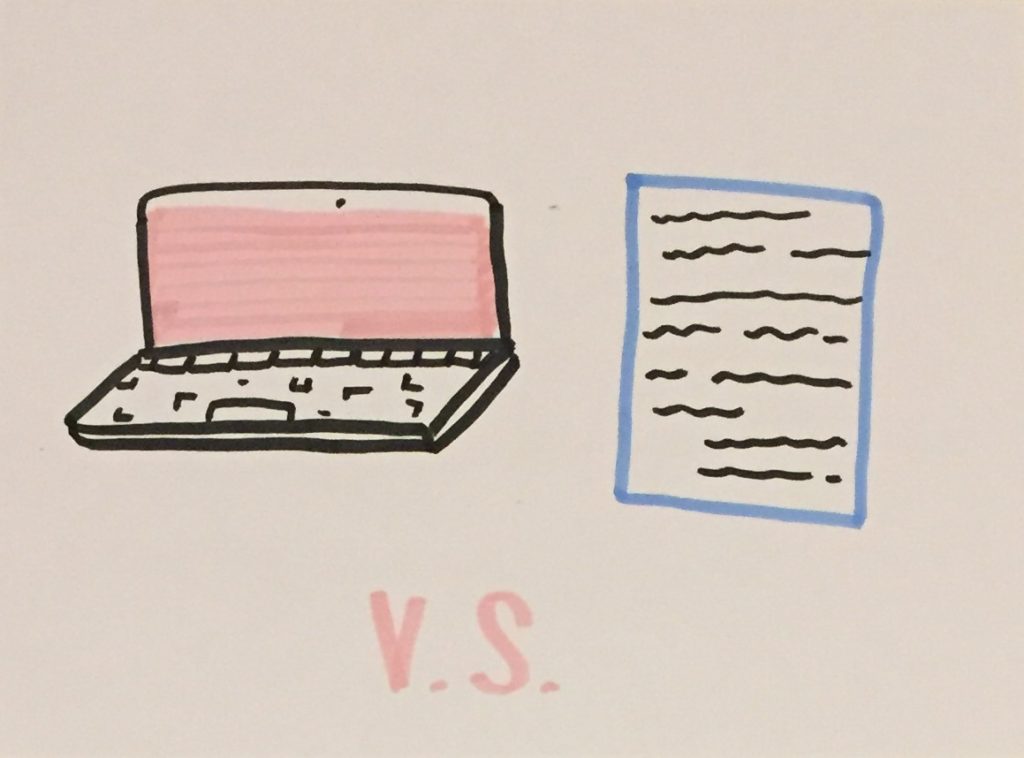
Is handwriting better than typing? Most likely, you know that the answer is yes. But why? And is it always yes? Read on to find out…
A study done by Pam A. Mueller, from Princeton University, and Daniel Oppenheimer of the University of California, Los Angeles found the reason. Mueller says that if you type your notes, you will have “this tendency to try to take verbatim [word-for-word] and write down as much of the lecture as they can.” However, it’s most likely that you can’t write as fast as you can type, and this means that you are “forced to be more selective, […] and that extra processing of the material benefits you.”
There are two types of note-taking according to Mueller and Oppenheimer: generative and nongenerative. Generative note-taking means taking information and summarizing it so you understand it more completely. Nongenerative is the same thing as copying. Think about it: do you study by re-writing the entire passage or by bullet-pointing and examining causes and effects?
Finally, there are two different theories as to why we should even take notes in the first place to study. The encoding hypothesis proposes that the processing your brain does when you summarize and annotate helps you learn and remember the knowledge. The external-storage hypothesis puts forth the idea that you take the notes so you have them to look back on later, and the looking back is what helps you learn.
The debate lies in which theory is correct: if the encoding hypothesis is true, then stock up on some number 2 pencils and scribble away! For those who can’t let go of their computer, just put your faith in the external-storage hypothesis and cite that when teachers tell you “no laptops!” (warning: use this at your own risk)
Source:
Staff, NPR, and James Doubek. “Attention, Students: Put Your Laptops Away.” NPR, NPR, 17 Apr. 2016, www.npr.org/2016/04/17/474525392/attention-students-put-your-laptops-away.